Solar Energy Storage Batteries
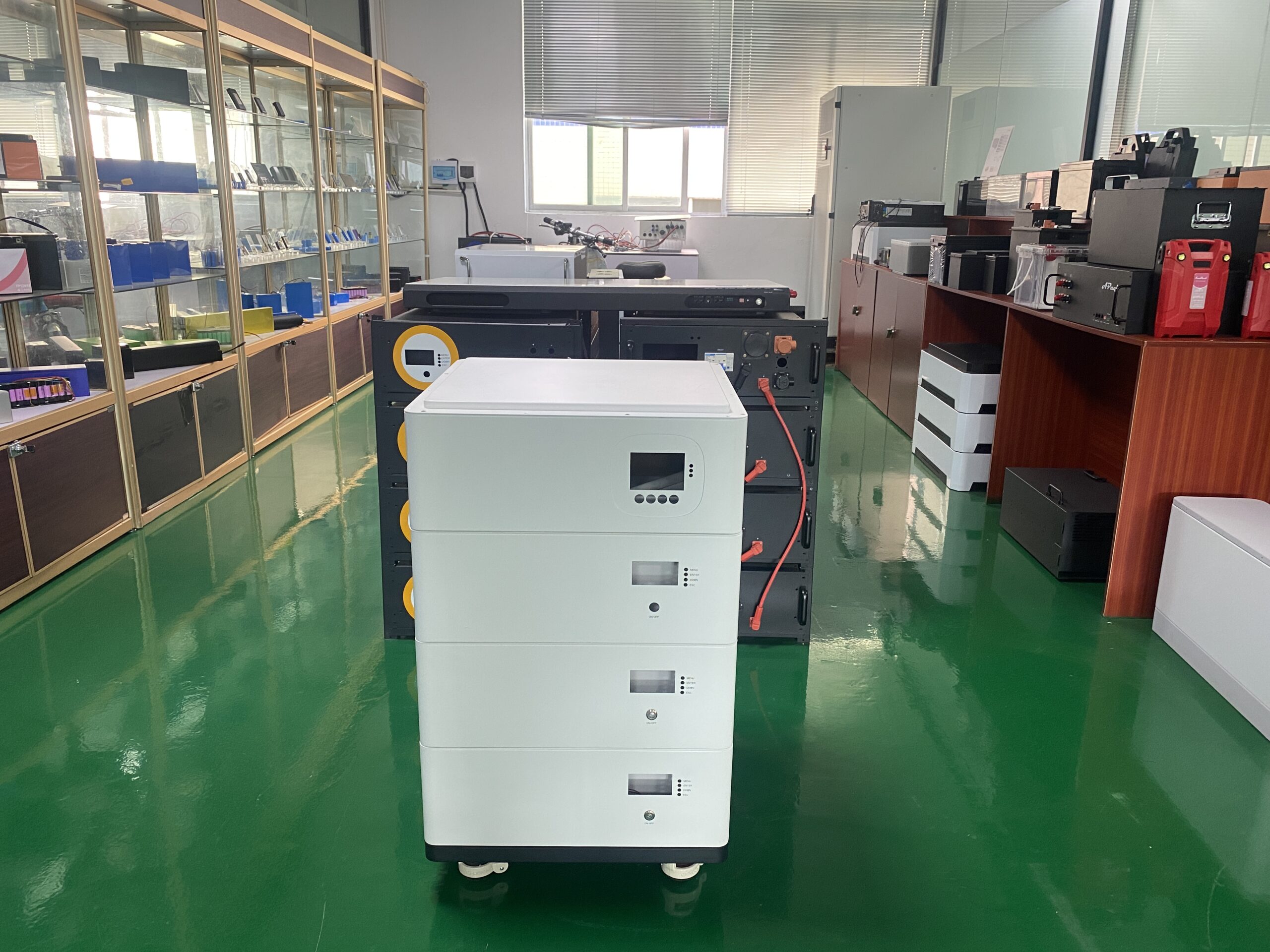
Home and commercial solar storage formats
A solar energy storage battery is specified by the format it has to fit and the load it has to carry. For residential systems, wall-mounted units keep the pack out of floor space and close to the inverter; for larger installations, rack formats group modules into a single bank. Both routes are built from the same cell and BMS platform, so the choice is mechanical and service-driven rather than chemical.
Our storage range covers 51.2V units in several capacity classes, in wall-mounted and rack formats. For smaller or legacy systems, 12V and 24V LiFePO4 building blocks allow a lithium ion solar battery bank to be assembled at lower voltage classes. The energy storage batteries page lists the standard configurations; a wall-mounted lithium battery suits plant rooms where floor area is tight.
For commercial solar battery storage, the rack format is usually the starting point: modules are stacked in a cabinet, cabled to a common DC bus, and serviced module by module. That structure matters when a site needs to expand later — capacity is added in blocks rather than by replacing the whole bank. Enclosure, mounting and cable entry are agreed in the project specification.
Inverter compatibility: the protocol check
Compatibility is decided by the inverter's battery protocol, not by the pack's voltage alone. A 51.2V pack and a 48V-class inverter may share a nominal voltage and still fail to communicate if the CAN bus message set differs. Before a quotation is written, we ask for the inverter model and check the protocol against the pack's BMS.
CAN bus and RS485 communication options are evaluated per project. The BMS firmware must speak the message format the inverter expects: start-up handshake, state-of-charge reporting, charge and discharge limits, alarm and protection flags. Where the protocol matches, the pack and inverter exchange those messages directly. Where it does not, the options are a protocol adaptation on the BMS side or a different communication route — both are confirmed during evaluation, not assumed.
Send the inverter model with your enquiry. We will state which communication option applies to your project and what the BMS will report. Closed-loop communication is the goal on most systems; open-loop, voltage-based operation is possible but places charge control on the inverter's own logic. Either way, the decision is recorded in the project specification so the installed system matches what was agreed.
Sizing capacity for overnight loads
Overnight capacity is sized from the loads to be covered and the hours of backup, not from a standard product size. The method is straightforward: list each load you want to run after sunset, multiply its watts by the hours it runs, and add the results to get the energy the bank must deliver. Then add margin for inverter losses, depth of discharge and the fact that loads rarely run exactly as scheduled. The result is a usable kWh figure, which is then matched to the nearest standard configuration.
Worked in outline: a load list of lights, refrigeration, networking and a pump, each with its own running hours, produces a daily overnight energy total in kWh. That total is matched to the nearest unit class; if it lands between classes, the margin decides whether you step up a size — a bank sized exactly to the calculated load has no room for a cold night or a heavier evening.
Two further inputs change the answer. Backup hours: covering a full night is a different requirement from covering a few hours of grid outage. And recharge window: the array has to refill the bank between cycles, so the solar input and the overnight load have to be considered together. Our team will work through the load list with you and plan a solar storage system around the result.
Several requirements sit outside this method — peak discharge current, three-phase loads, generator-assisted charging — and are resolved in the project specification. Where a site needs a non-standard voltage or capacity, custom battery solutions covers packs built to the application rather than to a catalogue size.
Frequently Asked Questions
Can the storage battery work with our inverter brand?
Compatibility depends on the inverter's battery protocol. We do not confirm compatibility by brand name. Send the inverter model and we will check whether its CAN bus or RS485 protocol matches the BMS, and confirm which communication option applies to your project. The result is recorded in the project specification before the order is placed.
What capacity do we need for overnight loads?
Capacity is sized from the loads to be covered and the hours of backup: multiply each load's watts by its running hours, sum the results, and add margin for inverter losses and depth of discharge. The outcome is matched to the nearest 51.2V unit class, or to a 12V/24V building-block assembly. Send your load list and we will work through it with you.
Tell us about your battery project
Send your device requirements — voltage, capacity, current, space and quantity — and our engineering team will evaluate cell selection, configuration and battery management against them.